
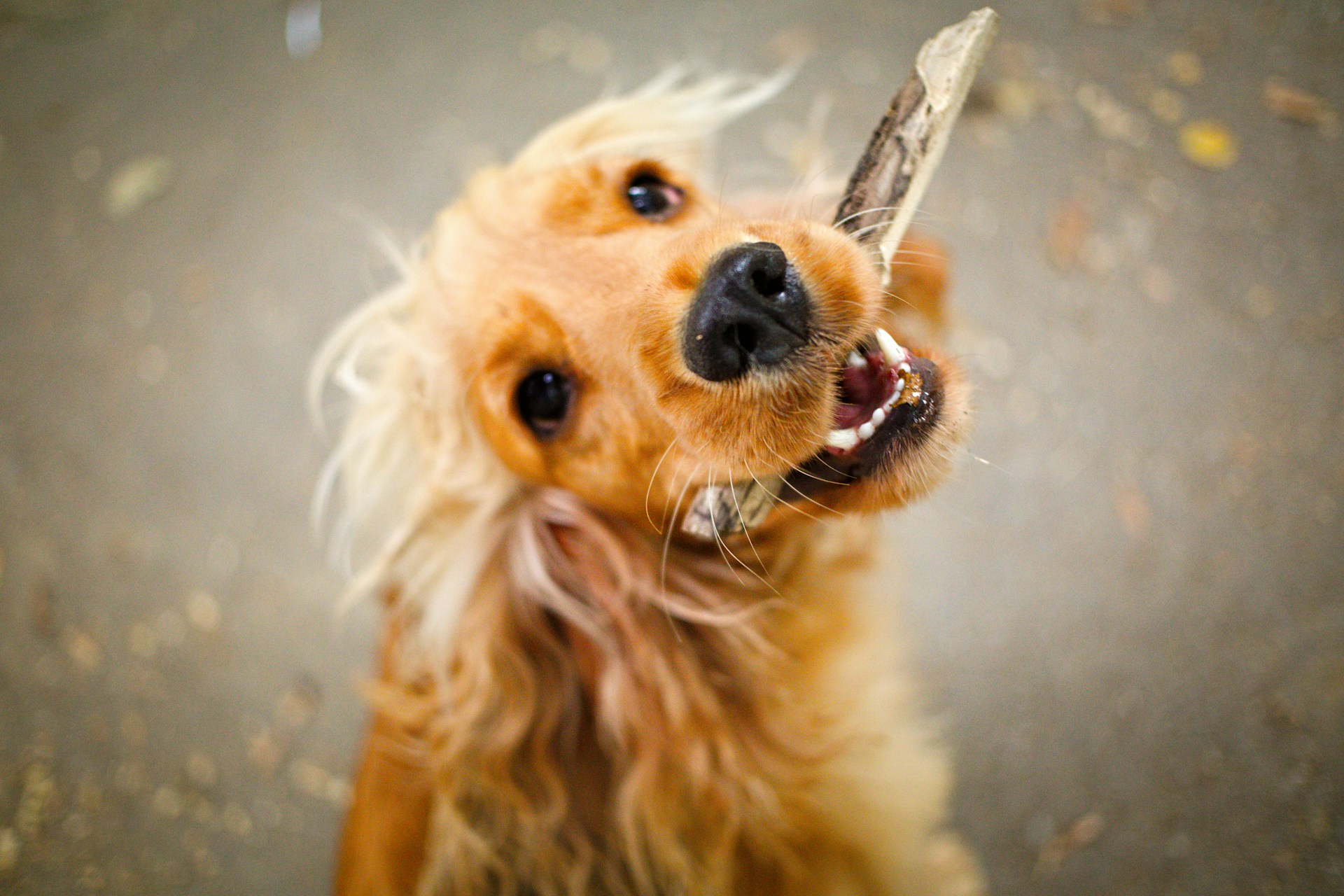
We’ve seen far too many broken teeth caused by gnawing on hard objects. So whenever someone asks us if it’s okay to let their dog chew on bones, our answer is always no.
A client once brought her dog in for a routine exam. She mentioned, almost as an aside, that she’d started giving him a raw knuckle bone from the butcher because it seemed more natural than store-bought treats.
But a closer look showed that this wasn’t a good idea. One of her dog’s upper carnassial teeth had a hairline crack running straight down the crown. She’d had no idea anything was wrong, and that’s actually pretty common. In fact, as many as 27% of dogs will fracture a tooth at some point, and their owners hardly ever see it happen.
Why Bones, Sticks, and Antlers Aren’t Safe for Dogs
Chewing or gnawing on hard objects is how most tooth fractures happen.
Bones, antlers, hooves, sticks, and hard plastic toys can all crack a dog’s teeth. They don’t flex or give under pressure the way a dog’s jaw does, and when a tooth meets something that hard, the tooth is what gives.
The enamel chips or splits, exposing the sensitive dentin underneath. Once a tooth is cracked, it can easily get infected. And since dogs are experts at hiding their pain, a broken tooth can go unnoticed for quite some time. It might even turn necrotic and fall out, after weeks or months of constant pain.
Bones and antlers don’t always crack a tooth outright. Sometimes they just grind it down over months of gnawing, especially in dogs who chew on hard objects all day long. Worn teeth in dogs can eventually expose the same sensitive inner structure as a fracture, it just takes more time.
Broken Teeth in Dogs Are More Common Than You’d Think
Somewhere between one in four dogs will crack a tooth at some point, so if your dog hasn’t yet, you’re actually the exception, not the rule.
Bite force testing on cadaver teeth has shown exactly how much pressure it takes to crack a tooth, and surprisingly, it doesn’t take an unusually strong bite. It only takes about 1,281 newtons of force to crack a dog’s fourth premolar, and that’s just the average. Plenty of dogs snap a tooth well below that number, so it really doesn’t take a hard bite or an aggressive chewer, just the wrong toy at the wrong angle. Any dog with the wrong chew toy is at risk.
And once in a while a broken tooth just disappears! If the crown breaks off at the gumline, the gum tissue can completely grow over the root of the tooth that’s left. It’s one of the sneakier ways that teeth go missing.
Safer Things to Let Your Dog Chew
Chewing itself is a normal, healthy activity for dogs. And we know how hard it is to deny a dog one of their favorite chew toys, whether it’s a stick they found on a walk or an antler from the pet store. But for your dog’s sake, it’s important to choose chew toys that don’t pose risk of injury.
Rubber toys with some give and appropriately sized dental chews all satisfy the urge to chew. Manufactured chews made from plastics like nylon or synthetic polymers with flavorings are ideal for aggressive chewers but you must throw them away before they get too thin and break into fragments. The key is to supervise them playing with these toys so they chew safely.
Rawhide chews might work, but you have to limit the amount because dogs can finish an entire chew in a single session.
Looking for a Vet Dentist in the SW Houston Area?
If your dog has been gnawing on sticks, bones, or antlers, it’s a good idea to get their teeth examined. X-rays will reveal problems like hidden fractures or painful tooth infections.
A cracked or broken tooth almost always needs to come out. But if your dog ever needs a tooth extraction, don’t worry. At Texas Veterinary Dental Center, tooth extractions are routine procedures. Your dog will be under general anesthesia, so they won’t feel a thing. And we’ll be monitoring them closely until they’re awake and have recovered enough to go home.
If your dog is due for a dental checkup or you have any concerns about their teeth, contact us to schedule an exam at our clinic in Stafford today.
Photo by Vidak on Unsplash used with permission under the Creative Commons license for commercial use 7/8/26.